B2B lead generation: what works in Australia
How to reach business buyers, qualify the leads, and follow them through a long sales cycle.
Book a call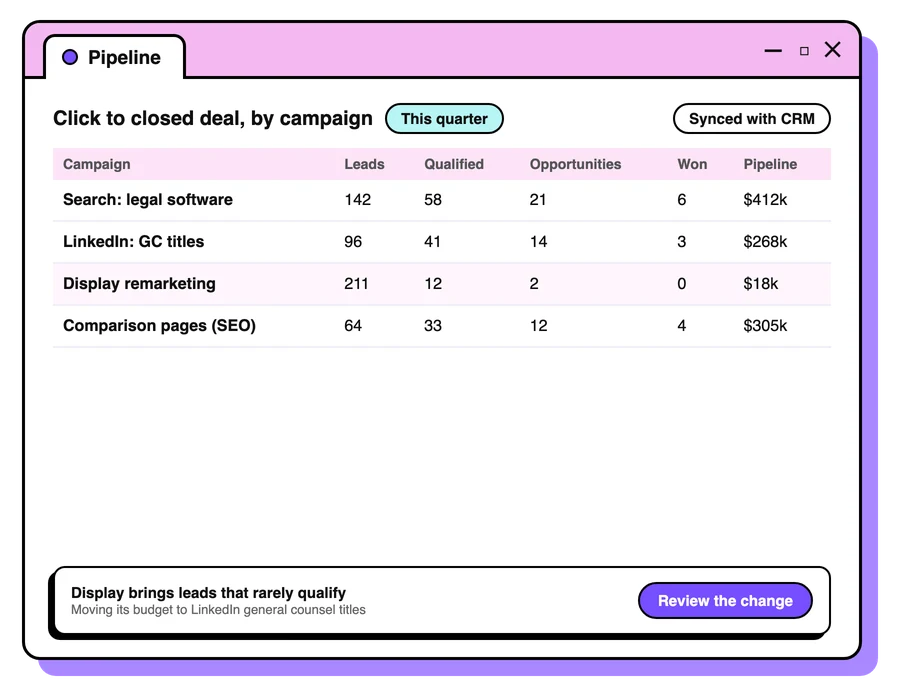

B2B lead generation is harder than selling to consumers. Fewer people buy, several of them have a say, and a decision can take months. The upside is that each customer is worth a lot, so a small number of good leads can transform a business.
Who buys, and who decides?
In most business purchases there's a user, a person who signs off the budget and someone who can say no, often IT or finance. Plan your marketing around the questions each of them asks. A user wants to know it will make their job easier; a finance manager wants the cost and the risk.
Build your plan around those audiences rather than around channels. Work out what each one needs to believe, then choose where to reach them.
Which channels work best for B2B lead generation?
- Google Search. Catches people actively looking for a solution. Bid on problem and category searches as well as product names, and send each to a page that answers that exact search.
- LinkedIn. Reaches people by job title, company size and industry. It costs more per click than other channels, but the targeting is unmatched for B2B. Use it for content and events as much as for direct offers.
- Meta. Often underrated for B2B. Decision makers scroll Instagram and Facebook too, and clicks cost much less than LinkedIn. Lead with the problem and the audience, and let the creative do the targeting.
- SEO and content. Comparison pages, pricing pages, how-to guides and answers to the questions buyers ask your sales team. These keep bringing in leads without paying for every click, and they're what AI tools quote.
- Founder and team outreach. For a new product or a small target market, a founder posting and reaching out on LinkedIn can open doors no ad can, especially when it's backed by a website and CRM ready to follow up.
- Events and webinars. A good event gives buyers a reason to give you their details. Put the speakers and the topic front and centre in the ads.
Qualify leads before sales spends time on them
Ask one or two qualifying questions on your forms, such as company size or timing. Then give your sales team a simple way to score each lead on its first conversation. Michelle Bourke, our founder, described this in 2018:
“A simple risk matrix calculator can be a useful addition for the sales team. It doesn’t have to be in depth, just an excel spreadsheet with a checklist of questions to ask and help score an incoming lead with an initial conversation can be enough.”
Test your scoring on past customers you won, lost and still have. If it would have picked the good ones, it's ready to use.
Follow leads all the way to revenue
In B2B, the lead is where the work starts. Connect your forms, calls and demo bookings to your CRM, and track each lead through qualified lead, opportunity and closed sale. Then report your marketing on cost per qualified lead and revenue, so budget goes to the campaigns that produce customers.
If you only close a handful of large deals a year, that's too few for Google or Meta to learn from directly. Optimise for the step before, such as a booked demo, and judge campaigns on the quality of those meetings. Then send the later stages back to the ad platforms: Google's offline conversion import "lets you see what happens in the offline world after someone clicks your ads", by matching each sale in your CRM to the click that started it.
Plan for a long sales cycle
- Set long lookback windows in your ad platforms and analytics, so a sale months after the first click is still credited. Google Ads counts conversions within 30 days of a click by default, and you can extend the conversion window to as long as 90 days.
- Keep in touch with leads who aren't ready: a useful email every few weeks, case studies, invitations to events.
- Run remarketing to people who visited your pricing or demo pages.
- Give your sales team content to send at each stage, from a one-page overview to a detailed business case.
Want a hand? Our performance marketing team runs B2B lead generation across Google, LinkedIn and Meta. You might also like our guides to lead generation strategies and marketing attribution.
Build a persona for each person in the deal
A buyer persona is a short profile of one type of person involved in buying from you: their role, what they're responsible for, what worries them and where they look for information. Most B2B businesses need two or three, one for each role in the decision you mapped out earlier.
Build them from real conversations. Talk to your sales team, read through won and lost deals in your CRM, and interview a few recent customers. A useful persona fits on one page and answers four questions:
- What problem does this person need solved, and how do they describe it in their own words?
- What would make them look good, or bad, inside their organisation?
- What objections do they raise before buying?
- Where do they go for information: Google, LinkedIn, industry associations, events or peers?
Then write ads, landing pages and emails for one persona at a time. The same product can be sold to an operations manager on time saved and to a finance manager on cost and risk, and each message lands better when it speaks to one of them.
Inbound and outbound lead generation
Inbound lead generation brings buyers to you through search ads, SEO, content and events they find while they're looking. Outbound means you go to them, with cold email, calls, LinkedIn messages or direct mail to a list of target companies.
Many B2B businesses generate their best pipeline from a mix of the two. Inbound leads arrive warmer because they came looking. Outbound lets you choose exactly which companies you approach, which matters when your market is small. The ABS counts of Australian businesses show how small it can be: at 30 June 2026, only 5,366 Australian businesses employed 200 or more people, and 68,325 employed 20 to 199. If you sell to large companies in one industry, your whole market may be a few hundred businesses.
Keep outbound personal and relevant: a short note that shows you understand the company's situation gets far more replies than a mass template. In Australia, commercial emails and texts also have to follow the Spam Act. The ACMA's guide to avoiding spam sets out the main rules: get consent, identify yourself as the sender, and make it easy to unsubscribe, honouring each request within 5 working days. Keep a record of consent, because as the ACMA puts it, "it's up to you to prove that you have a person's consent."
Capture more of the leads you generate
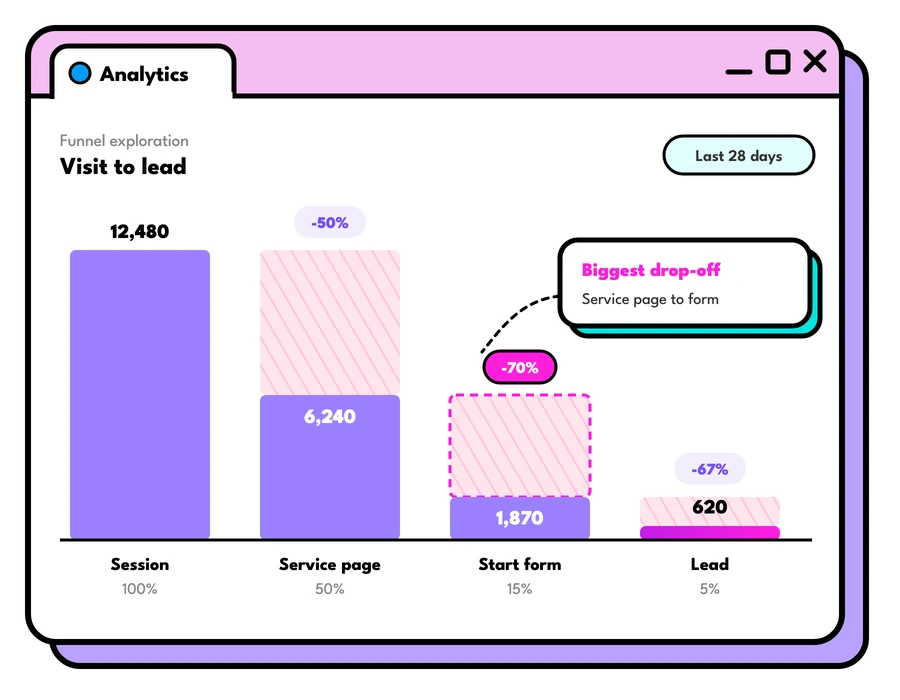
Generating interest is half the job. Capturing it, so the person becomes a contact your team can follow up, is where many B2B campaigns leak.
- Offer more than one way to get in touch: a short contact form, a phone number, a demo booking calendar and, for early-stage buyers, a useful download in return for an email address.
- Use LinkedIn Lead Gen Forms on LinkedIn ads. They fill in details from the person's profile, so they're quick to complete on a phone.
- Send every lead into your CRM automatically, tagged with the campaign it came from, so nothing sits in an inbox.
- Reply quickly. A lead who hears back the same day is still thinking about the problem; one who waits a week may already be talking to a competitor.
- Capture early interest too. Remarketing lists and email sign-ups let you stay in touch with people who aren't ready to talk yet.
Marketing qualified leads and sales qualified leads
Leads arrive at different stages of readiness. Sorting them into two groups keeps marketing and sales working from the same definitions.
- Marketing qualified lead (MQL): a lead that fits your target customer and has shown interest, such as downloading a guide, attending a webinar or visiting your pricing page more than once. Marketing keeps nurturing these.
- Sales qualified lead (SQL): an MQL your sales team has checked and agreed is worth pursuing now, usually because there's a clear need, a budget and a timeframe. These go to sales for direct contact.
Write both definitions down with your sales team, agree what happens when a lead moves from one stage to the next, and review them every few months. When marketing reports on SQLs as well as MQLs, everyone can see which campaigns generate real sales conversations, and the rate at which MQLs become SQLs shows which channels bring in the right people.
The B2B lead generation process, step by step
B2B lead generation works best as a system: know who's involved in the decision, reach each of them where they look, capture every enquiry, qualify it against agreed definitions and follow it all the way to revenue. If you're generating plenty of leads but few sales, start with qualification and follow-up before spending more on ads. If you're short of leads, start with one or two channels you can run well, measure them on qualified leads and sales, and add more once they're working.
A worked example: judging channels on revenue
Cost per lead can point you to the wrong channel in B2B, because the cheapest leads are often the least likely to buy. Here's a worked example with made-up numbers for a hypothetical South Melbourne IT services firm that splits $6,000 a month between Google Search and LinkedIn.
- Google Search: $3,000 brings 40 leads at $75 each. Sales qualifies 6 of them, so each sales qualified lead costs $500, and 1 deal closes.
- LinkedIn: $3,000 brings 12 leads at $250 each. Sales qualifies 6, also $500 each, and 2 deals close, at $1,500 of ad spend per deal.
On cost per lead, Google looks more than three times cheaper. On deals won, LinkedIn did twice as well for the same spend. One month is far too few deals to decide on, so in practice you'd track this over a full sales cycle, but the process is the same: follow every lead to qualified, opportunity and won, and move budget to the channel that produces revenue.


Questions people ask
What is B2B lead generation?
Finding businesses that could buy from you and getting their decision makers to raise their hand: book a demo, ask for a quote or download something useful.
Is LinkedIn worth it for B2B lead generation?
For reaching specific job titles and industries, yes, though clicks cost more. Many B2B businesses get the best results combining LinkedIn's targeting with cheaper reach on Meta and intent on Google Search.
How do I measure B2B lead generation?
Track leads through to qualified leads, opportunities and sales in your CRM, and report each channel on cost per qualified lead and revenue as well as lead volume.
How long does B2B lead generation take?
Paid channels can bring enquiries within weeks, but with long sales cycles it can take a few months to see which campaigns lead to sales. Plan to judge them over a full sales cycle.
What's the difference between an MQL and an SQL?
A marketing qualified lead (MQL) fits your target customer and has shown interest, such as downloading a guide. A sales qualified lead (SQL) is one your sales team has checked and agreed is ready for a sales conversation now.
Does outbound still work for B2B?
Yes, when it's targeted and personal. Outbound suits businesses with a small, well-defined market. In Australia, commercial emails and texts must follow the Spam Act: have consent, identify yourself and include an easy way to unsubscribe.
What is a B2B buyer persona?
A one-page profile of one type of person involved in buying from you, such as the user, the budget holder or IT. It covers their goals, worries, objections and where they look for information, and it guides what you say to each of them.
Keep reading
Lead generation strategies that work
Lead generation strategies that work: how to bring in better leads from Google, Meta and LinkedIn, measure the ones that become sales, and cut the waste.
Read the guide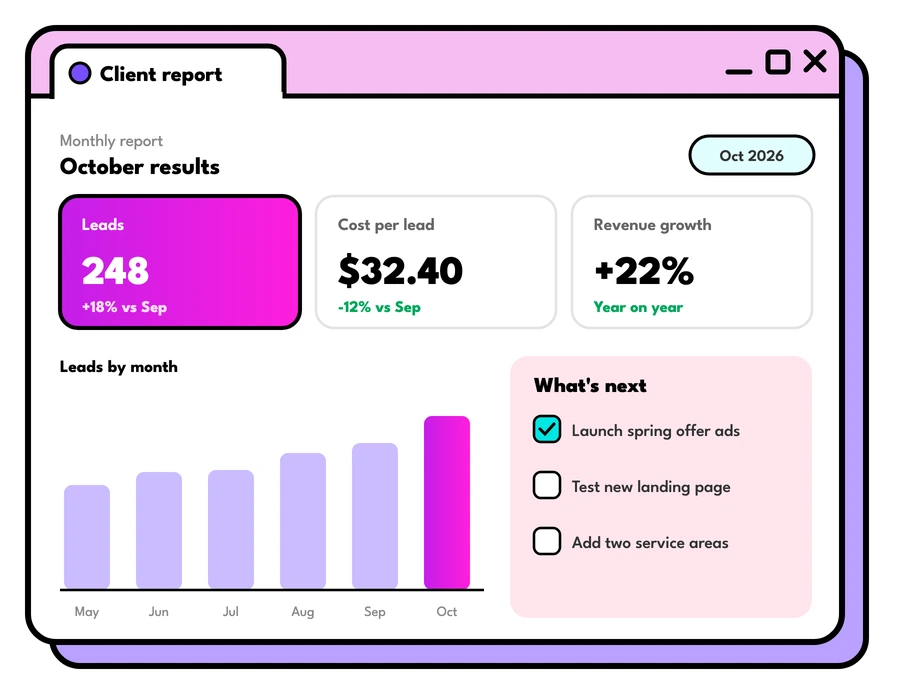
Cost per lead Australia: what a lead costs, by industry
Cost per lead Australia: what Google Ads clicks and leads cost across 13 industries, from Australian search data, and how to work out your own.
Read the guide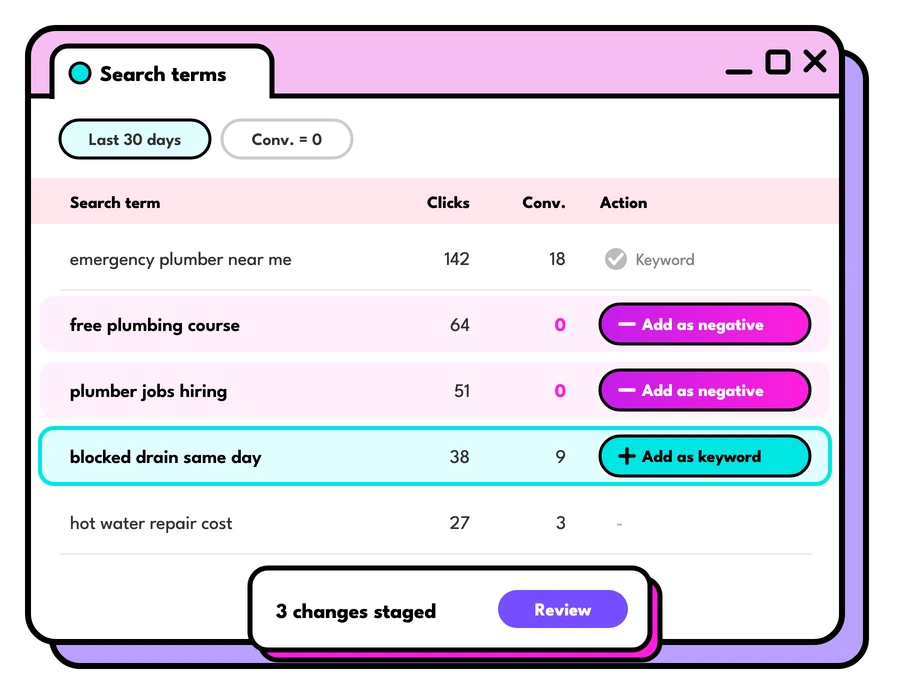
Google Ads search terms report
How to use the Google Ads search terms report to find new keywords, cut wasted spend and win more of the traffic that turns into enquiries.
Read the guideLet's talk about your goals
Tell us what you're working towards and we'll show you where we'd start.
Book a strategy call