Generative engine optimisation (GEO)
What GEO is, how it compares with AEO and AI SEO, and what Australians search.
Book a call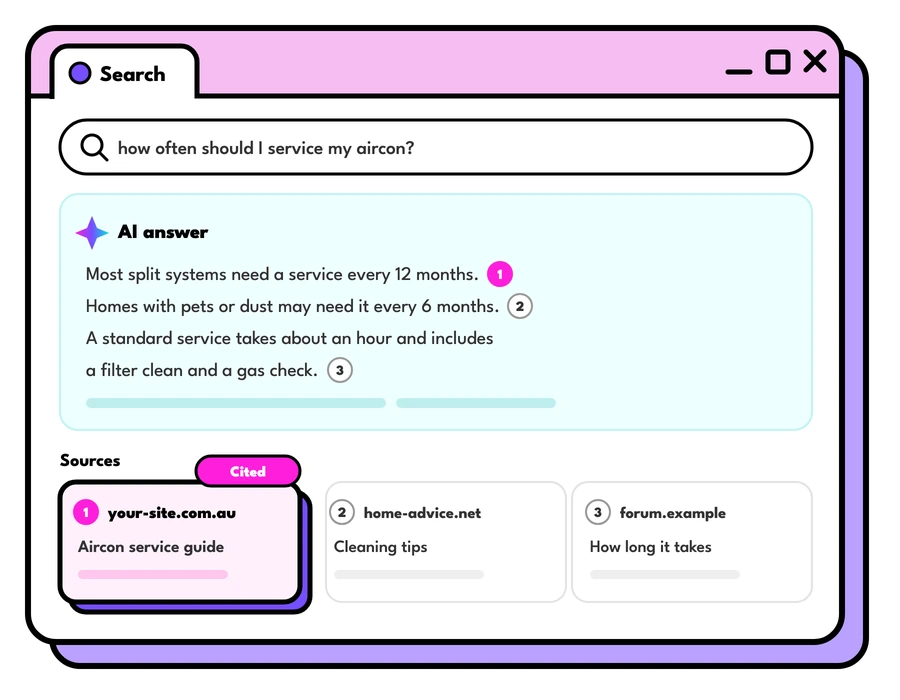

Generative engine optimisation (GEO) is the work of getting your business found, named and cited in the answers that AI tools write, such as ChatGPT, Gemini, Perplexity and Google's AI Overviews. Marketers argue about what to call it: GEO, AEO, AI SEO or AI search optimisation. Here is what each term means, how GEO differs from SEO, the strategies that work, and what Australians actually type into Google, from Ahrefs' search data for Australia in November 2026.
Key takeaways
- Generative engine optimisation means making your content easy for generative AI to find, trust and quote, so your brand appears in AI-generated answers.
- GEO, answer engine optimisation (AEO), AI SEO and AI search optimisation describe almost the same work. The labels differ more than the practice.
- GEO builds on SEO rather than replacing it. AI search tools lean on pages that already rank and are trusted.
- What changes is how you measure it: you have to ask the AI tools directly, more than once, because their responses vary.
- Australians search "AI SEO" most, about 1,300 times a month. "Generative engine optimisation" gets about 600, almost all from people asking what it means.
What is generative engine optimisation?
Generative engine optimisation is the practice of shaping your website and your wider online presence so that generative AI tools use your information when they answer a question. A traditional search engine shows a list of links and lets the user choose. A generative engine reads many sources, writes one answer, and may cite a few of them. If your business isn't in what it reads, or isn't trusted, it won't be in the answer.
The name comes from a 2023 research paper by academics in the United States and India, which tested how changes to a page's content affected whether AI-generated answers used it. They found that pages with clear sources, quotations and statistics were more likely to be used. The term has since been picked up by the SEO industry as a label for the whole field.
What are generative AI engines?
A generative engine is any tool that answers a query by writing a response rather than listing results. The ones most Australians meet are:
- ChatGPT, which can search the web before it answers and show the sources it used.
- Google's AI Overviews and AI Mode, which put a written answer above, or instead of, the usual search results.
- Gemini, Google's assistant, and Microsoft Copilot, built into Windows and Bing.
- Perplexity, an answer engine that cites its sources in every response.
Each is built on a large language model (LLM), a model trained on huge amounts of text to understand and write language. Some answer only from what the model learned in training. Others look information up on the web first, which means changes to your content can show up much sooner.
Why GEO matters
More people now ask an AI tool instead of scrolling a page of results, and the answer they get is short. When someone asks "who's the best accountant in Cheltenham?", the response names a handful of businesses. Being one of those names is a new kind of visibility, and being left out is a new kind of invisible.
It matters for small businesses in particular. In our own study of Melbourne trades and building businesses, most were never recommended by AI in three asks. The gap is rarely about the quality of the business. It's about how much the AI can read about it and back up.
AI answers also send fewer clicks than a list of links, because the user often gets what they need on the page. That makes being named in the answer, and described correctly, more valuable than an extra position in the rankings.
What Australians actually search
Australians search AI SEO more than any other label: about 1,300 times a month. AI search optimisation and AI SEO agency follow at about 700 each. Generative engine optimisation (GEO) gets about 600 searches, almost all from people asking what it means. AEO agency is small but the fastest riser, up about 11 times in a year.
| What people search | Searches a month in Australia | Change over a year | What they want |
|---|---|---|---|
| ai seo | 1,300 | up 58% | Mixed: what it is, and who does it |
| ai search optimisation | 700 | about double | Mixed: Google's guide, then agencies |
| ai seo agency | 700 | about double | To hire someone |
| generative engine optimisation | 600 | flat | A definition |
| aeo agency | 450 | about 11 times | To hire someone |
| answer engine optimisation | 400 | up 37% | A definition |
| llm seo | 300 | about 3.6 times | Mixed |
| chatgpt seo | almost none | Searched as "chat gpt seo" |
Ahrefs' figures are estimates of the monthly average. The change compares the last 12 months with the 12 before. Comparison searches are smaller: "geo vs seo" gets about 200 a month, and "aeo vs geo" and "aeo vs seo" about 150 each.
GEO, AEO and AI SEO: what each term means
Generative engine optimisation (GEO)
The academic name, from the 2023 research paper. It is mostly searched by people asking what it is, and the results are owned by large software companies. "GEO" alone is too ambiguous to be useful, since it also means geography and location targeting.
Answer engine optimisation (AEO)
The same idea, framed around answers rather than search results: being the business an assistant names when someone asks a question. On its own, "AEO" mostly means something else in Australia (customs certification, or a clothing brand), so it is best written out the first time.
AI SEO
The broadest label. Some people mean using AI tools to do SEO; others mean doing SEO so AI tools find you. Because it is ambiguous, it draws the most searches and the most mixed results.
AI search optimisation
Making a business easy for AI search to find, trust and recommend. Google uses this plain wording in its own guidance, and Australian spelling matches how Australians search it.
AEO vs GEO: is there a difference?
In practice, very little. GEO is used more for AI chat tools that write long answers, and AEO for anything that gives a direct answer, including voice assistants and Google's featured snippets. The strategies are the same.
GEO vs SEO: is it different?
Mostly it builds on it. Generative engines lean on the same things good SEO already needs: clear pages about each service, accurate business details, structured data, and being mentioned by sources the tools trust. Google says its AI features draw on the same systems as its search results, so pages that rank well are more likely to be used.
The differences are in emphasis and in measurement:
- A place in the answer. SEO aims for a position in the search results. GEO aims to be part of the answer, which may have no positions at all.
- Your whole brand, beyond your pages. An AI system weighs what many sources say about your brand, across the web as well as your own site.
- Measured by asking. A ranking report doesn't tell you whether ChatGPT names you, so you have to ask the tools directly, more than once, because their answers change from one ask to the next.
Can you do GEO without SEO?
Not really. A site that search engines can't crawl, or that nobody links to or mentions, gives generative AI little to work with. Traditional SEO is the foundation, and GEO is the extra work on top.
GEO strategies and best practices
These are the generative engine optimisation strategies we use for clients, and the ones the evidence so far supports.
1. Answer real questions in plain language
Write content that answers the questions your customers actually ask, including the longer, more specific ones people put to AI tools. Lead with the answer, then explain. Content that rambles before it gets to the point is harder for a model to quote.
2. Structure your content so it can be quoted
Use clear headings, short paragraphs, lists and tables. Put one idea in each section. A well-structured page lets an AI system lift a precise answer without guessing what you meant.
3. Back up your claims
The original research found that sources, quotations and statistics made content more likely to be used. Cite where your facts come from, give specific examples, and use real figures where you have them. Never invent them.
4. State the facts about your business the same way everywhere
Your name, what you do, where you work and who you work with should read the same on your website, Google Business Profile and directory listings. Consistent information helps a model understand your brand as one thing.
5. Add structured data
Schema markup for your organisation, services, reviews and FAQs states the facts in a form machines can read. It doesn't guarantee anything, but it removes guesswork.
6. Let the crawlers in
Check that your robots.txt doesn't block the crawlers AI tools use, unless you have a reason to, and that your key pages load quickly and render without needing scripts to show their text.
7. Earn mentions from relevant, trusted sources
Reviews, industry associations, local business networks, partner pages and publications in your field all feed what an AI knows about you. This is usually the slowest part of GEO, and often the part that makes the difference.
How to measure generative engine optimisation
There is no official GEO ranking. What you can measure is what the AI says when you ask it:
- Write the prompts real customers would use when they look for a business like yours.
- Ask each one several separate times and record how often you are named, since the answer changes from one asking to the next.
- Note who else is named and which pages are cited as sources.
- Repeat with the same prompts on a schedule, so a change is a real change.
Where you can, connect it to enquiries in your analytics, so you can see the business it brings in.
Which term should you use?
- Talking to customers: "getting recommended by ChatGPT and Google's AI answers". Nobody needs the acronym.
- Naming the service: "AI search optimisation", with "AI SEO" alongside it.
- In a brief or a job ad: write out "answer engine optimisation (AEO)" or "generative engine optimisation (GEO)" so nobody guesses.
See where you stand
Our free check asks the AI behind ChatGPT three separate times for the best businesses in your field and area, and shows whether you were named.
Run the free AI visibility check
Want it done for you? See AI search optimisation and AI SEO at Foresight Digital.
How we did it
Search volumes, difficulty and 12-month trends are from Ahrefs Keywords Explorer for Australia, pulled on 4 November 2026. We update this page each quarter. The table is free to reuse with a link to this page.

Keep reading
AI ads are here
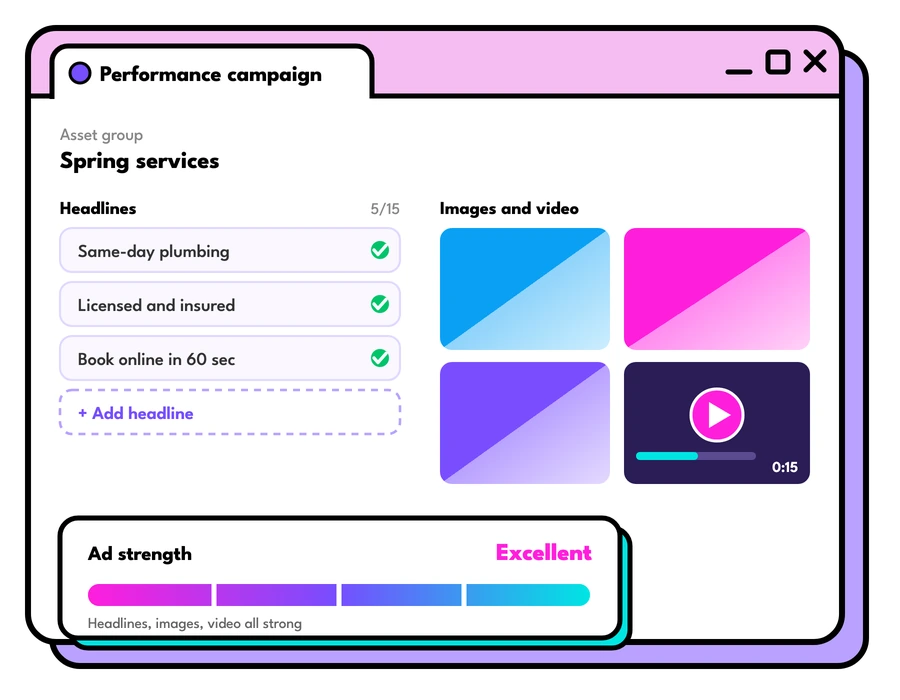
AI ads are now part of Google and Meta. What AI-driven campaigns do well, where they go wrong, and how to keep people in charge of the decisions.
Read the guide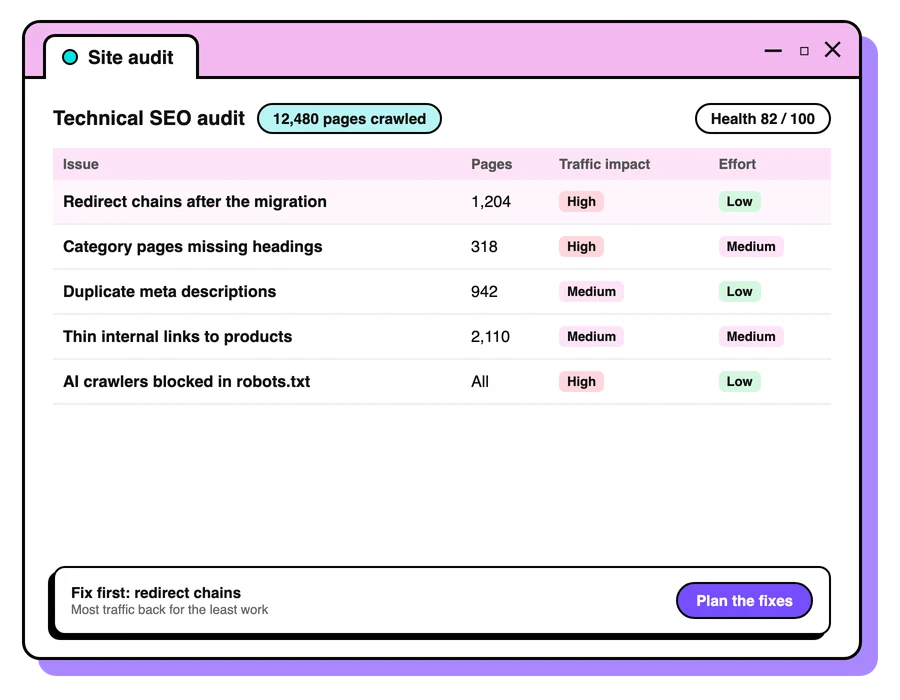
14 SEO mistakes to avoid
Eleven SEO mistakes we see on business websites, why each one costs you traffic and enquiries, and how to fix it. Practical advice from a Melbourne agency.
Read the guide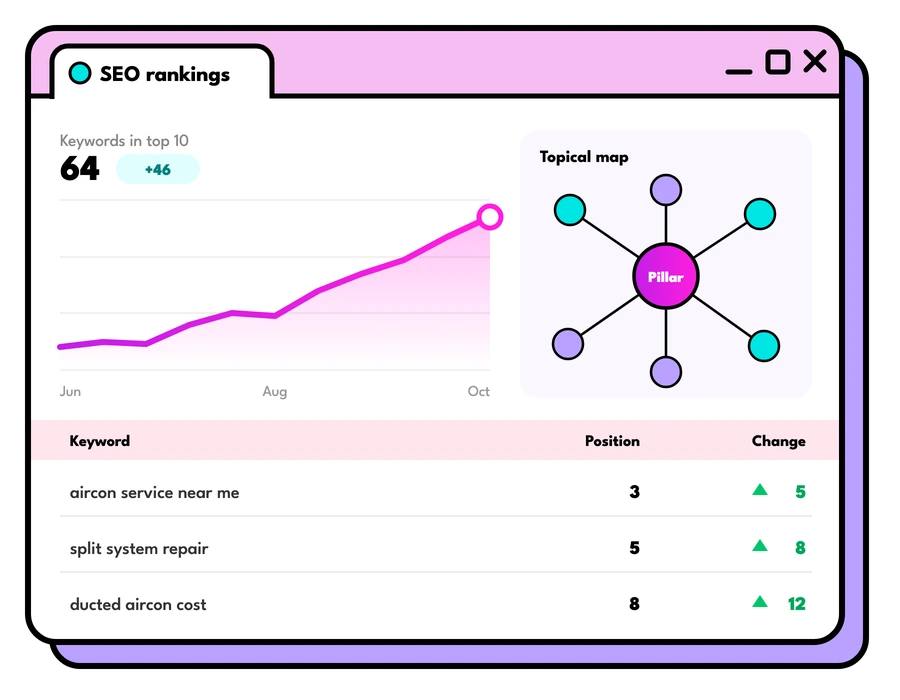
SEO pricing Australia: what SEO and ads cost
SEO pricing Australia: what SEO and Google and Meta ads management cost, what moves the price, and our own starting prices, before you ask.
Read the guideLet's talk about your goals
Tell us what you're working towards and we'll show you where we'd start.
Book a strategy call