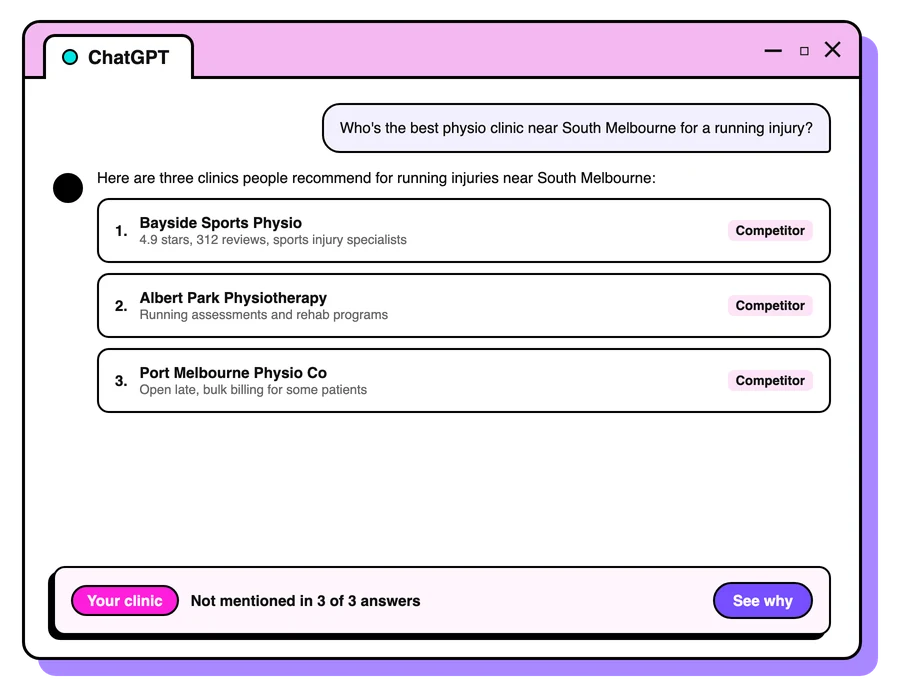

More people now skip the list of links and ask an AI assistant instead: "Who's the best accountant in Cheltenham?" "Which container hire company in Melbourne is reliable?" The assistant answers with a few names. AI search optimisation is the work of making sure yours is one of them, and that what the AI says about you is right.
How we get you recommended
AI assistants don't know your business. They build an answer from what they can find and trust, so we work on four things:
- Deeply understanding the questions your buyers ask AI, and who gets named today
- Making your website easy for AI to read, quote and get right
- Getting you mentioned by the reviews, directories and publications AI trusts
- Measuring it properly, with every prompt asked three separate times




Nobody controls what AI says. We make you the easiest business for it to find, understand and back up.
The work comes in four steps. Scroll down or click one of the links below to learn more about each:
1. Find out where you stand
We start with an outside-in check. We ask the AI behind ChatGPT what your buyers would ask, three separate times for each prompt, and record whether you were named, who was named instead, and what was said. The answers change from one ask to the next, and asking three times shows whether you're named reliably or only by chance.
A business can be excellent at what it does and still be left out: its website doesn't say clearly what it does, where and for whom; AI crawlers can't read the site; few trusted sources mention it; or its competitors are simply mentioned more often. The check shows which of these is holding you back.
ChatGPT

About 900 million people use it every week, and it now carries ads in Australia too.
AI Overviews and AI Mode

AI Overviews reach over 2 billion monthly users, and AI Mode has been live in Australia since October 2025.
Gemini, Perplexity and Copilot

They read many of the same sources, so the work carries across.
2. Make your website easy for AI to quote
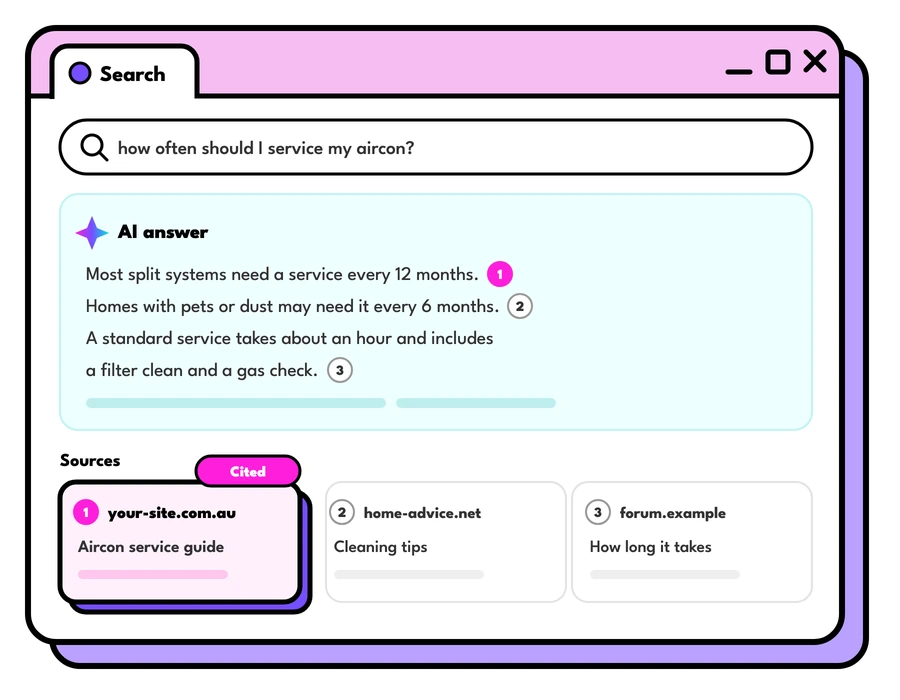
We write content that covers what your buyers really want to know, in plain language, on the pages where it belongs, and we state the facts about who you are, what you do, where you work and who you work with the same way everywhere.
We add structured data (schema) for your business, services, reviews and FAQs, so machines can read the facts without guessing. And we check that AI crawlers can reach the pages that matter: OpenAI's OAI-SearchBot, for example, decides whether your site can appear in ChatGPT search, so a robots.txt that blocks it by accident keeps you out.
Answer-ready content
Clear statements of what you do, where and for whom, which AI quotes far more readily than slogans.
Structured data

Business, service, review and FAQ schema, tested and kept in line with the page.
AI crawler access

The bots behind ChatGPT search and other assistants allowed in, unless you have a reason to keep them out.
3. Get mentioned by the sources AI trusts
When an AI system recommends a business, it's repeating what it has read. A brand described the same way on its own website, its Google Business Profile, review sites and industry directories gives the AI a consistent story to repeat. A brand that only talks about itself gives it little to go on.
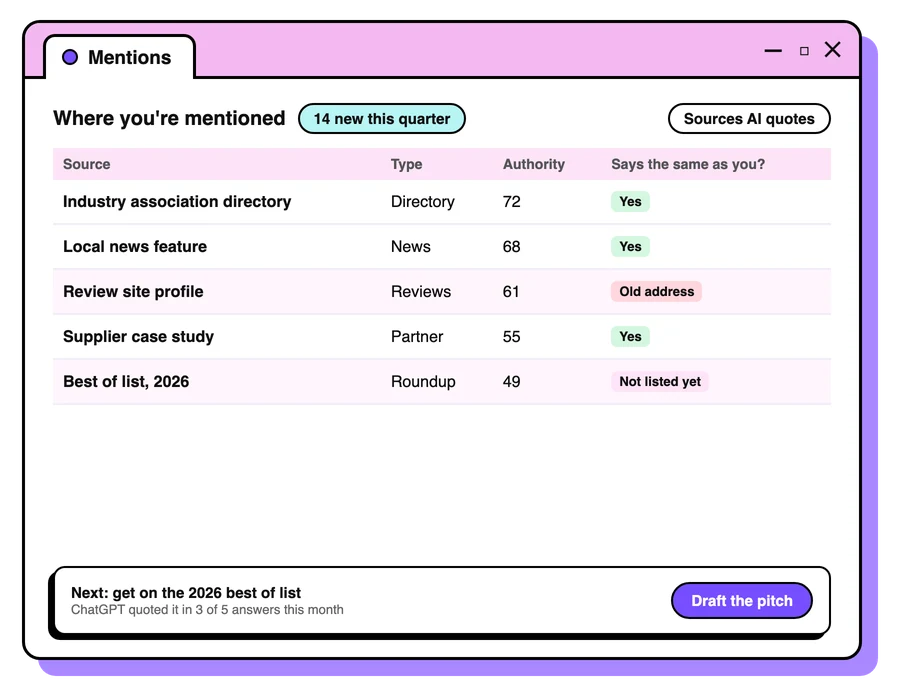
So we work on getting you listed, reviewed and mentioned where it counts for your industry: directories and "best of" lists, industry associations, local business networks, review platforms and the publications that cover your field. This is the slowest part of the work and often the part that makes the difference.
Reviews

In BrightLocal's 2026 US survey, 45% of consumers used AI tools for local recommendations, up from 6%.
Directories and best-of lists

The lists and listings AI leans on in your category, found and worked through.
Industry publications

Mentions in the press and associations that cover your field.
4. Report in plain English
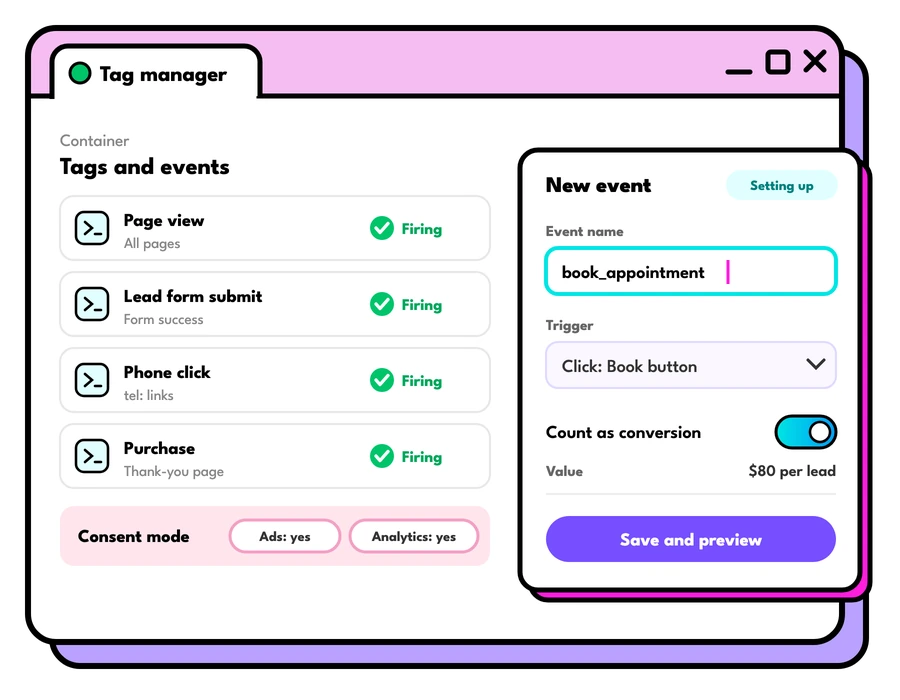
Each month you see which prompts you were named for, how often across the repeated asks, who else was named, and what we changed. Where we can, we connect this to enquiries through your analytics, so you're watching business results as well as a visibility score.
AI answers draw heavily on pages that already rank well in Google, so this work sits on top of good AI SEO. And while it builds, which takes months rather than weeks, Google Ads and Meta ads can bring in enquiries now.
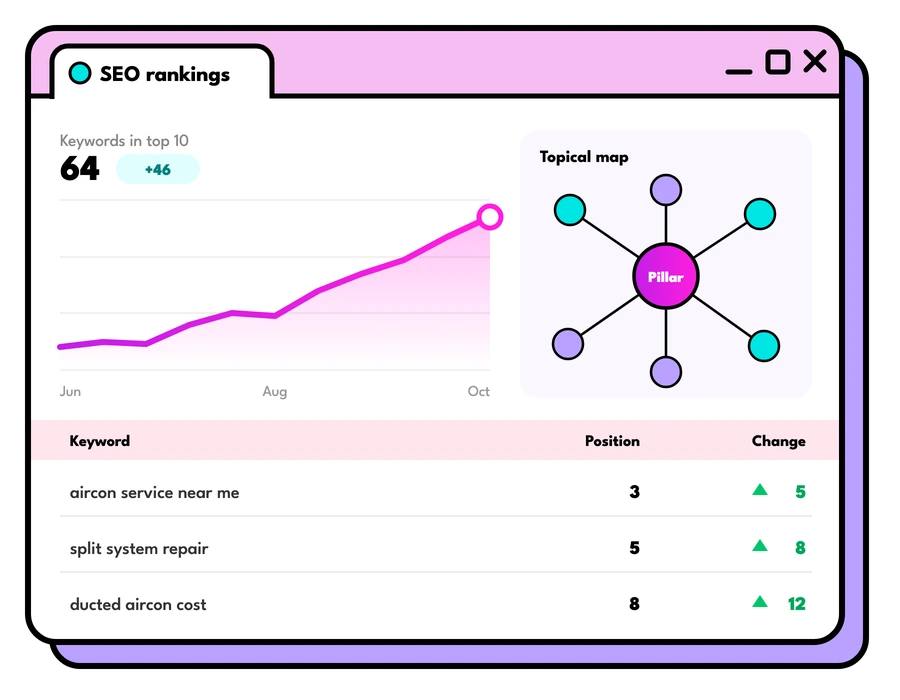
Results from our answer-focused search work

+312%
Increase in featured snippets, the answer boxes Google shows above the results, from localised keyword research and content.
+37%
Year-on-year growth in website clicks from organic search.
Salesforce
- Localised keyword research
- Content shaped to win featured snippets, Google's answer boxes
- Link building and conversion analysis
- Ranking for an additional 388 targeted keywords
What is generative engine optimisation?
Generative engine optimisation (GEO) is another name for AI search optimisation: shaping your content and reputation so generative AI tools, such as ChatGPT, Gemini and Google's AI Overviews, use it in their responses and name your business. The term comes from a 2023 research paper led by researchers at Princeton University. They tested changes to web pages and found that some, such as citing sources, adding statistics and quoting experts, lifted visibility in AI responses by up to 40%.
The lesson for businesses is practical. Generative AI favours content that's specific, backed up and easy to quote, so that's how we write and optimise your pages.
Building authority AI can see
AI tools decide who to name partly on authority: how often trusted sources mention you, and whether they agree about what you do. Authority on your own site comes from clear expertise, named authors and real examples. Authority off your site comes from reviews, directories, industry associations and the press. We work on both, because AI looks for the same story in both places.
Why AI search optimisation is ongoing
AI answers change as models update and new sources appear. To stay visible, we track the same prompts every month, refresh pages when the facts change and keep adding new mentions, so your visibility holds as the tools move on.
Next steps: start this week
You can make a start before you speak to anyone. Here are five things you can do this week to optimise your business for AI search:
- Ask the questions yourself. Put three questions your buyers would ask into ChatGPT and Google, and note who's named and what's said about you.
- Check your robots.txt. Make sure it lets OAI-SearchBot and Googlebot reach the pages that matter.
- Say what you do, plainly. Your home page should state what you do, where and for whom in its first few lines.
- Update your Google Business Profile. Categories, services, hours and photos, complete and accurate.
- Ask for reviews. Ask every recent customer for a Google review, and reply to each one.
Want a faster read on where you stand? Our free AI visibility check asks the AI behind ChatGPT about your business three separate times and shows you each response.
Ways to work with us
Start small or hand it over. Every way comes with the same people and the same checks.
A free AI visibility check
For anyone wondering whether AI recommends them.
- We ask AI the questions your buyers ask
- You see where you're named, and who is instead
- Results straight away
Free
Run the free checkWe run your AI search optimisation for you
For businesses that want it done well, without the hours.
- Strategy, set up and daily management, AI-assisted
- A named person who knows your account
- Monthly reporting on leads and sales, in plain English
From $5,000 a month
Book a callYour whole marketing team, AI-powered
For businesses that want everything done, every week.
- Google Ads, Meta, creative, SEO, tracking and AI CRO, all included
- Our AI agents work on it every day, a specialist signs off every change
- Weekly updates, a scored re-audit every quarter and monthly credits for growth projects
From $10,000 a month, plus ad spend
Ask about the AI planSome love from the brands we've worked with
This strategy has far exceeded any of my expectations. It’s the best I have seen in many years.
Dealing with your team has really opened up the team’s eyes to what is possible and the level of professionalism they should be expecting of other agencies, and delivering in return as a client.
Let's talk about your goals
Tell us what you're working towards and we'll show you where we'd start.
Book a strategy callWhat else is worth asking? Glad you asked!
What is AI search optimisation called?
It goes by several names. Answer engine optimisation (AEO), generative engine optimisation (GEO), AI SEO and LLM SEO all mean the same thing: getting your business found, named and described correctly by AI tools such as ChatGPT, Gemini and Google's AI Overviews.
What is answer engine optimisation (AEO)?
Answer engine optimisation is the work of making your business the answer when someone asks an AI assistant or a search engine a question. It covers clear content that answers real questions, structured data, technical access for AI crawlers, and mentions from sources the AI trusts.
What is AEO vs SEO?
SEO aims to rank your pages in Google's list of results. AEO aims to get your business named inside the answer itself, whether that's ChatGPT, Gemini or Google's AI Overview. They overlap a lot: AI answers draw on pages that already rank well, so AEO builds on good SEO.
What is the difference between AEO and GEO?
In practice, very little. GEO (generative engine optimisation) is usually used for AI chat tools like ChatGPT, and AEO for anything that gives a direct answer, including Google's AI Overviews and voice assistants. The work is the same, and most agencies use the terms interchangeably.
How do you optimise for AI search?
Make it easy for AI to find, understand and trust you. Say clearly on your website what you do, where and for whom. Answer your buyers' real questions. Add structured data. Make sure AI crawlers can reach your pages. Then get mentioned by trusted sources in your industry, and check the results by asking the same questions repeatedly.
How do I choose an SEO agency for AEO visibility?
Ask how they'll measure where you stand now, which questions they'll track, how many times they ask each one, and how they report change. Ask what they'll do beyond your own website, since mentions elsewhere matter. Be wary of anyone who guarantees a place in AI answers.