How to get recommended by ChatGPT
How AI search picks businesses, and what an Australian business can do about it.
Book a call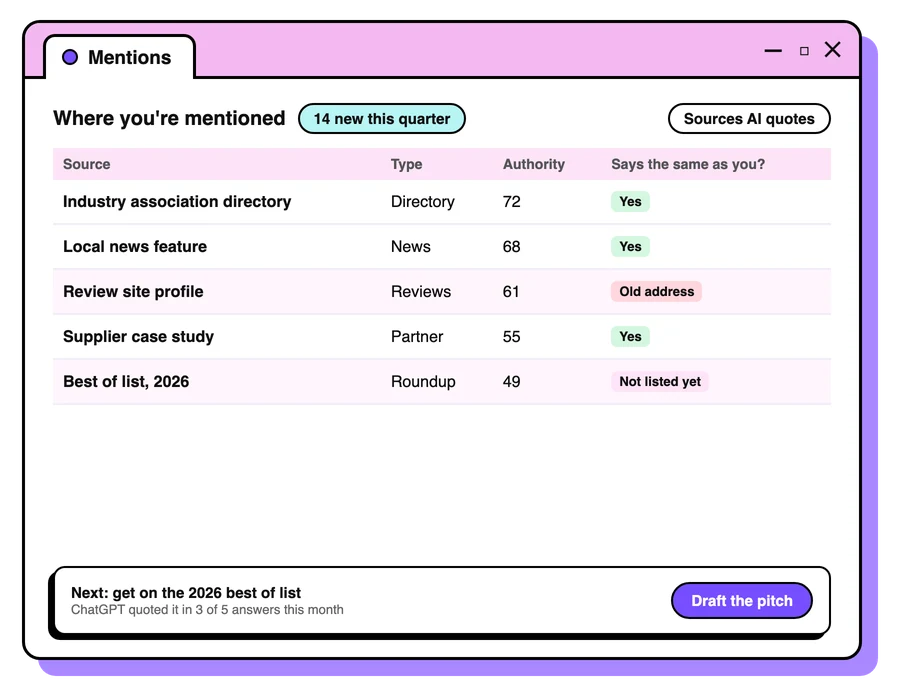

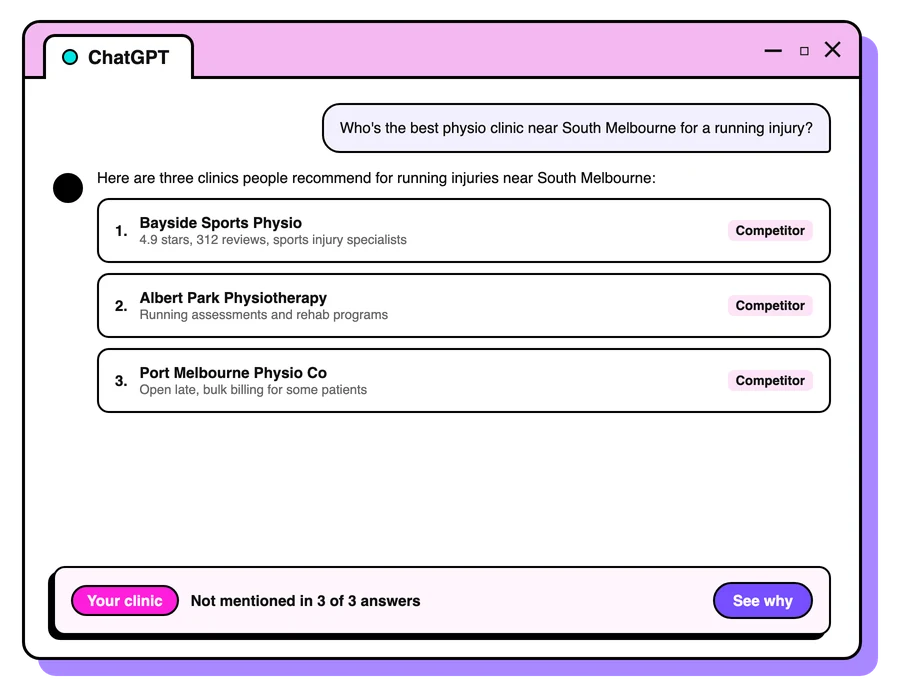
More Australians now ask ChatGPT, or read Google's AI answer, before they pick a business. Ask "who's the best accountant in Geelong?" and you get a short list of names with a reason next to each. If you're on that list, you're in the running. If you aren't, that customer may never reach your website.
The good news is that the AI tools have told us a fair bit about how they choose. Here's what OpenAI and Google say officially, what we've seen in practice, and the steps we'd take for an Australian business.
How ChatGPT search finds businesses
When ChatGPT searches the web, it rewrites the question into one or more searches, reads the pages it gets back, writes an answer and cites the sources it used. OpenAI's help article on ChatGPT search says it sometimes works with third-party search providers to do this, and may share a general location with them to return local results such as nearby businesses.
OpenAI's crawler: OAI-SearchBot
OpenAI's crawler documentation says OAI-SearchBot is the bot used to surface websites in ChatGPT search, and that sites which block it won't be shown in ChatGPT search answers. It's separate from GPTBot, the crawler that collects training data, so you can allow search and block training if you prefer. OpenAI notes a robots.txt change can take around 24 hours to take effect.
The Bing connection
OpenAI doesn't publish a list of its search partners, though Microsoft is a long-standing one. Testing written up by Search Engine Land found ChatGPT's local answers lined up closely with Bing's web results. We'd treat that as a strong hint rather than a rule: if Bing can't find and index your site, you're making ChatGPT's job harder.
How Google's AI answers choose sources
Google is clear on this. Its guidance on AI features says there are no extra requirements or special optimisations to appear in AI Overviews or AI Mode. A page needs to be indexed and eligible to show in Google Search with a snippet. Google also says there's no special structured data you need to add for AI features, and any structured data you do use must match what's visible on the page.
Google explains that AI Mode and AI Overviews may run several related searches across subtopics (it calls this query fan-out), which is why they often cite a wider mix of pages than the classic top ten. Google's advice is familiar: let it crawl, use clear internal links, keep important content as text, and keep your Business Profile current.
For local recommendations, Google says its local ranking rests on relevance, distance and prominence, and that prominence draws on what's said about you across the web, including review count and rating. That's the same reputation an AI answer leans on when it describes why a business is a good pick.
What the AI is looking for
Put the official guidance together and the pattern is simple. AI tools recommend businesses they can find, understand and trust:
- Findable. Your site can be crawled by Google, Bing and OAI-SearchBot, and its pages are indexed.
- Understandable. Each service and location is described clearly on its own page, in plain text, so the AI can match you to the question.
- Trusted. Other sources back you up: reviews, directory listings, industry associations, local media and "best of" lists.
Steps for an Australian business
1. Check nothing is blocking the crawlers
Look at your robots.txt file (yourdomain.com.au/robots.txt) and check that Googlebot, Bingbot and OAI-SearchBot aren't disallowed. Ask your web host or developer whether a firewall or bot-protection setting is blocking them as well. This is one of the most common reasons a good business never shows up.
2. Get indexed in Bing as well as Google
Verify your site in Google Search Console and in Bing Webmaster Tools, submit your sitemap to both, and fix any errors they report. Bing supports IndexNow, which tells it straight away when you publish or update a page, and many website platforms switch it on with a plugin.
3. Give every service and location its own clear page
If you're a plumber covering Melbourne's south-east, have a page for each main service and the areas you serve, written the way customers ask. Say who you help, where, what it costs or how pricing works, how long it takes and why people choose you. Short answers to common questions on the page help too, because that's the language people type into ChatGPT.
4. Add accurate structured data
Neither Google nor OpenAI requires special markup for AI answers. Accurate LocalBusiness structured data still helps search engines confirm your name, address, phone, hours and service area, and it costs little to add. Keep it in line with what's on the page and on your Business Profile.
5. Build reviews and keep your profiles consistent
Keep your Google Business Profile complete, with the right categories, service areas, hours and photos, and ask happy customers for reviews regularly. Make sure your business name, address and phone number match everywhere: your site, Bing Places, Apple Business Connect, industry directories and the Yellow Pages.
6. Earn mentions on other sites
AI answers lean heavily on third-party sources. Get listed by your industry association, pitch local media, offer expert comment to journalists, sponsor something in your community, and ask to be considered for credible "best of" lists in your area. A mention from a respected Australian site tells the AI that people other than you rate your business.
7. Keep it fresh and measure the traffic
Update key pages when prices, services or team members change. In Google Analytics, look for visits referred by chatgpt.com and other AI tools so you can see whether the work is bringing people in.
How to check whether AI recommends you
Ask ChatGPT the questions your customers ask, such as "best electrician in Moorabbin" or "who does commercial cleaning in Parramatta". Ask more than once, because AI answers change from one ask to the next. Note whether you're named, which competitors are, and which sources the AI cites. Those sources are a ready-made list of places to get mentioned.
To make it quicker, use our free AI visibility check. It asks the AI behind ChatGPT three separate times for the best businesses in your service and area, and shows how often you were named. You can read more about how it works on our AI visibility checker page, and see what we found across Melbourne businesses in our Melbourne AI visibility study.
Frequently asked questions
Can I pay to be recommended by ChatGPT?
No. Organic recommendations in ChatGPT can't be bought, and Google says there's no way to pay for a better local ranking.
How long does it take to start being recommended?
Technical fixes such as unblocking crawlers can show up within days or weeks. Building reviews and third-party mentions takes months. Most businesses see a steady improvement over a quarter or two rather than a sudden jump.
Do I need an llms.txt file?
Google says you don't need new machine-readable files or special markup to appear in its AI features, and OpenAI's crawler guidance focuses on robots.txt. We'd spend the time on your pages, profiles and reviews first.
Is this the same as SEO?
It builds on the same foundations: crawlable pages, clear content and a good reputation. The extra focus is on being mentioned by other trusted sources and answering customer questions directly. We cover this in more depth in our guide to generative engine optimisation.
Check your own business for free, or book a call and we'll show you where we'd start.

Keep reading
Melbourne AI visibility study
The AI visibility of Melbourne trades: how often AI recommends them, and how many of their websites can measure a lead. Original data, free to reuse.
Read the guide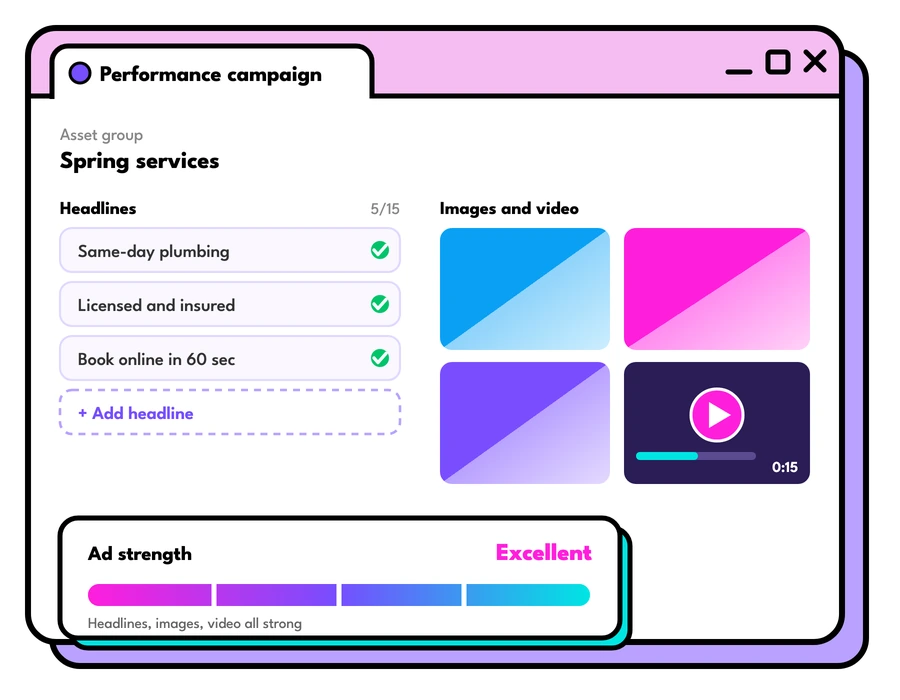
AI ads are here
AI ads are now part of Google and Meta. What AI-driven campaigns do well, where they go wrong, and how to keep people in charge of the decisions.
Read the guide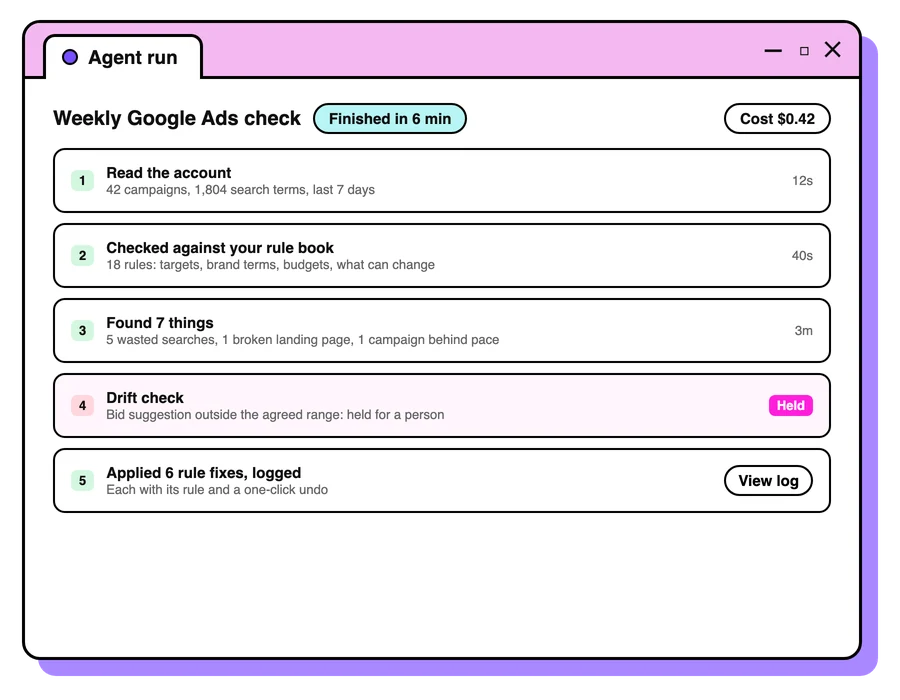
AI for small business: what's worth using now
AI for small business: the practical ways to use AI in your marketing and operations now, how to brief it well, where it falls short and how to stay safe.
Read the guideLet's talk about your goals
Tell us what you're working towards and we'll show you where we'd start.
Book a strategy call